Saint Luke’s Hospital Investigation into Drug Diversion
The Good Nurse: A True Story of Medicine, Madness, and MurderSaint Luke’s Hospital’s investigation into drug diversion exposed a dangerous gap between recognizing that medications had gone missing and determining whether patients had been harmed. In 2002, nurses discovered evidence that vecuronium bromide and other drugs had been removed from the cardiac care unit’s supply. Staff voiced concerns about unexplained patient deterioration and deaths, but the hospital’s internal inquiry did not identify Charles Cullen’s role. Its closure did not end the matter: Nurse Pat Medellin carried her suspicions outside the hospital, and later investigations established that Cullen had killed patients there.
Discovery of missing drugs and mounting concern
The investigation gathered urgency as nurses tried to understand the appearance of unauthorized medication in a unit where patients were critically ill. Vecuronium bromide was a powerful paralytic, and the patients then on the unit had not been prescribed it. Staff members Gerry Kimble, Candy Wahlmark, and Kim Wolfe decided to watch the medical storage room after the discovery of opened containers and concern about the amount of the drug that had been reconstituted. Their attention turned to Cullen when he entered the room during a shift. After he left, Kim and Wahlmark found that the sharps box was full again and alerted unit manager Ellen Amedeo.
When staff and security examined the sharps box at the next shift change, they found several dozen drug bottles, many empty, including ten spent vials of vecuronium. The drugs had already been used on Edward O’Toole, though the nurses did not yet know that. The discovery prompted risk manager Janice Rader to arrange regular checks of the sharps box and to consult risk management director Ken Vail. With Cullen due back on shift within hours, the hospital sought advice from its in-house counsel, Seymour Traub, who brought in outside counsel Paul Laughlin. The immediate question of how to handle missing drugs thus became an institutional investigation in which possible patient harm was already part of the concern.
A method difficult to see
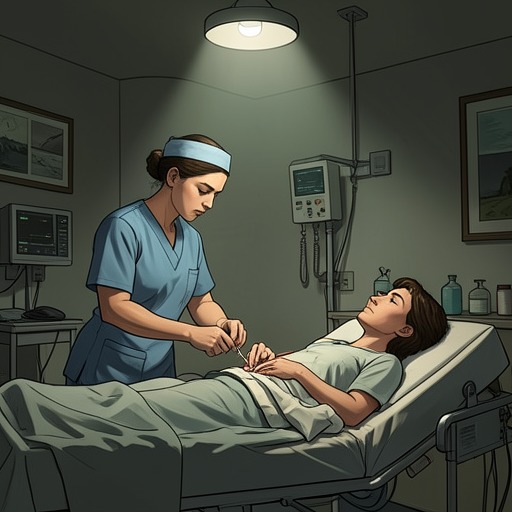
The book sets the investigation against the medication routines that gave Cullen access while making his actions appear ordinary. On one occasion, he injected digoxin into the IV line of an elderly patient through its piggyback port, an access point nurses routinely used to flush lines. He disposed of the vial and needle in the sharps box, then waited at the nurses’ station and took part in the later code. On another shift, he entered the medication room while stocking supplies, prepared syringes, and put altered IV bags among the named patient trays. In each case, work that looked like routine nursing activity concealed the intervention.
The hospital’s systems did not automatically expose that pattern. Amy Loughren later reconsidered Cullen’s habit of standing near the hallway doors and taking medication deliveries from the pharmacy runner. What had seemed like helpfulness—relieving the runner of the delivery tote and stocking the unit—also gave Cullen access to drugs without using the Pyxis system. The account emphasizes how ordinary access, isolated rooms, medication handoffs, and the privacy of bedside care could make drug diversion difficult to detect. That context helps explain why finding missing medication was not, by itself, enough to establish which patients had been harmed or who had harmed them.
The inquiry is closed despite a nurse’s warning
Medellin’s later testimony described a direct warning to Laughlin. After learning that opened vecuronium containers had been found and that nurses worried patients might have been harmed, she told him that unauthorized vecuronium could explain unexplained slowing of patients’ heart rates followed by codes. She also stressed that no one in the unit should have been receiving the drug. According to her account, Laughlin told her the investigation was closed and that he was confident Cullen was not harming patients.
Medellin challenged that confidence by pointing to work she said had not been done: comparing medications delivered by the pharmacy with medications actually administered, and comparing the frequency of codes on day and night shifts when Cullen was working. Laughlin nevertheless maintained that his experience as a prosecutor supported his conclusion and told her the matter would not be reopened. Medellin also said that supervisors Thelma Moyer and Amedeo dismissed her concerns. She compiled a list of patients who had died in the cardiac care unit and compared their deaths with Cullen’s shifts, but feared repercussions and did not present it to them. The episode turned on a consequential divide: staff concerns existed, but the hospital’s decision-makers did not convert them into an inquiry that, in Medellin’s account, would test the suspected pattern.
Additional reviews and an inconclusive result
After returning from leave in July 2002, general counsel Traub directed Laughlin to prepare a report and ordered further chart reviews. Rader and a nursing supervisor reviewed the charts of patients who had died during the weekend when the diverted drugs were found. The supervisor later testified that she had not previously conducted such a review and did not know its purpose when asked to examine the charts. Rader testified that Laughlin had told her he could find no evidence of foul play. The reviewers identified neither suspicious administration of vecuronium nor suspicious deaths, and the additional inquiry failed to uncover Cullen’s involvement. The hospital referred him to the State Board of Nursing for follow-up as it saw fit.
The accounts recorded in later civil litigation did not align neatly. Laughlin recalled recommending chart reviews to determine whether diverted vecuronium had been improperly administered, but said particularized suspicion that Cullen had harmed patients had not been brought to his attention. Medellin’s testimony and interview notes allowed a different inference about what he had been told. The book preserves that discrepancy rather than treating the hospital’s internal process as a settled or transparent investigation. After prosecutors referred the matter to law enforcement, the hospital commissioned further reviews, including an outside physician’s examination of patient charts; those reviews still did not lead Saint Luke’s to conclude that Cullen had harmed patients.
The police investigation and the failure’s significance
Medellin did not accept the hospital’s assurance. On August 29, 2002, she told an acquaintance at the Easton, Pennsylvania, Police Department that she suspected Cullen was responsible for unusual deaths. The concern moved through police and coroner channels to the Lehigh County district attorney’s office, where state troopers interviewed Saint Luke’s staff. Nurses described patients who had seemed to be recovering and then died unexpectedly, sometimes after Cullen changed their IVs. Lynn Tester calculated that Cullen had worked 26 percent of the hours but was present for 58 percent of the deaths. Another nurse recalled that the unit averaged twenty to twenty-two Code Blues per month while Cullen worked there, then had no code for six months after he left.
Those recollections raised a pattern, but pattern recognition was not the same as proof. An outside pathologist reviewed records for seventeen patients selected by the hospital and found nothing prosecutable in the paperwork. Meanwhile, Charles Cullen moved on to Somerset Medical Center with neutral references. The later investigation into Reverend Florian Gall’s death showed the evidentiary problem in stark form: toxicology established digoxin poisoning and homicide, while medication records could show Cullen’s access but could not alone prove murder. Ultimately, Cullen confessed to killing, among others, the five Saint Luke’s patients whose deaths were at issue in the civil suits; seven patients have been specifically identified as his victims at the hospital. The investigation’s significance lies both in the discovery of drug diversion and in the distance between warnings, internal conclusions, and the eventual confirmation of what had happened to patients.